

2026 Outlook for Corporate Citizenship and Philanthropy
Drawing on a recent survey of 70 corporate citizenship leaders, this report examines how companies are adjusting citizenship and philanthropy budgets, priorities, partnerships, and capabilities amid an evolving economic, policy, and reputational landscape.
Trusted Insights for What’s Ahead
- Corporate citizenship budgets enter 2026 largely stable, although 52% of leaders said they expect to allocate more resources toward volunteering, while a significant minority anticipate reductions in cash grantmaking and sponsorships.
- Many companies are preparing for greater discipline around allocation and timing of citizenship grants and expenditures, as the new US 1% charitable deduction floor reinforces tighter portfolio management and more deliberate pacing of cash grants.
- Thematic priorities are narrowing toward broadly shared, economically grounded needs— notably food security, affordability, housing, and digital inclusion—while issues carrying higher political or reputational exposure show the steepest pullbacks.
- Nonprofit fragility is emerging as a material execution risk: only 15% of leaders described partners as very or somewhat stable, with most attributing fragility to federal funding cuts.
- Delivering impact in 2026 is constrained by both internal and external pressures, as sustained expectations to demonstrate business value coincide with uncertainty around nonprofit capacity, political polarization, and media scrutiny.
- AI adoption within citizenship teams remains early stage and exploratory (55% of respondents), with key priorities for 2026 focused on staff literacy, reporting and analysis automation, and building foundational readiness before extending AI into higher-impact or outward-facing applications.
| Corporate citizenship, or corporate social responsibility, is the established business practice of companies supporting communities and society through philanthropy, employee volunteering, and nonprofit partnerships. It is typically led by a dedicated corporate citizenship team or affiliated corporate foundation, though responsibilities are often dispersed throughout the company. |
Budgets, Resources, and Operating Conditions
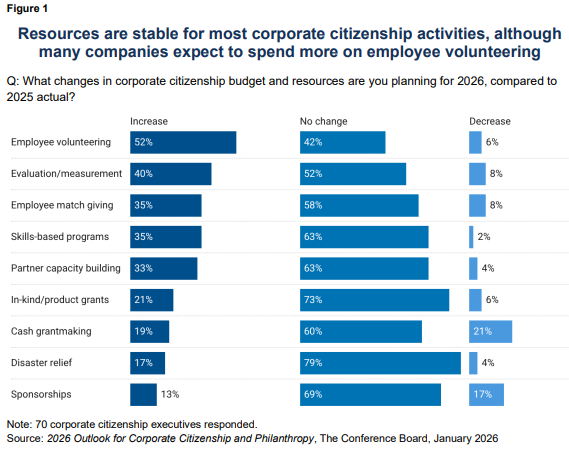
Corporate America entered 2026 amid uneven economic conditions: moderate GDP growth in 2025 was supported by resilient consumer demand, strong corporate earnings, and supportive fiscal policy, even as slowing job growth, tariff headwinds, cost pressures, and policy uncertainty tempered optimism. In this context, most corporate citizenship leaders do not anticipate dramatic shifts in resources and budgeting (Figure 1).
Where budget increases are planned, many relate to people-based engagement, especially employee volunteering and matched giving. These activities require limited incremental cash while delivering visible community presence and clear benefits for employee engagement and retention. Consistent with this, 57% of respondents to a different question in the survey expected employee volunteering and engagement to increase in 2026, compared with just 5% anticipating a decline. The pattern reflects broader workforce dynamics and reinforces the need for closer integration between corporate citizenship and HR as companies use community engagement to support connection, purpose, and retention.
Cash grantmaking may present the greatest downside risk: more organizations planned to decrease cash grants (21%) than increase them (19%). A similar dynamic is evident for sponsorships, where 17% of respondents expected resource reductions. This likely reflects tighter budget discipline, heightened economic uncertainty, and growing scrutiny of whether grantmaking has a clear connection to business objectives. In this context, corporate citizenship leaders may benefit from reframing the conversation in 2026 away from “how much we give” and toward where they focus, how effectively they execute, what risks they mitigate, and what organizational capabilities they build.
A new factor also shaping corporate citizenship budgets in 2026 is a change to the US tax code enacted in the 2025 budget reconciliation bill and taking effect this year. [1] Previously, corporations could deduct aggregate contributions up to 10% of taxable income—calculated after ordinary business deductions, but before applying the charitable deduction, any net operating loss carryback, or other special deductions. While the 10% cap remains, only aggregate charitable contributions above 1% of taxable income now qualify for deduction.
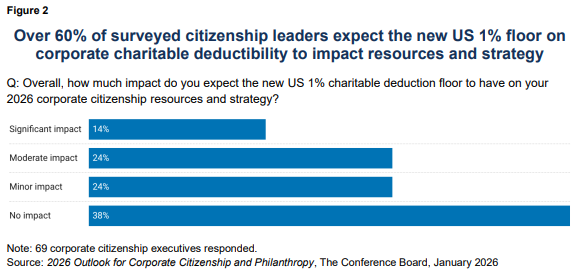
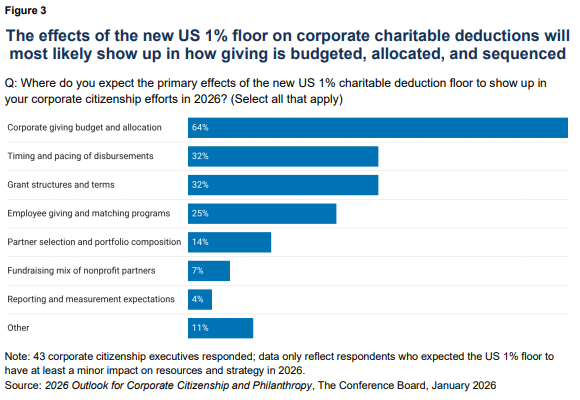
Survey results suggest the impact of the 1% floor will be real but manageable, with only 14% anticipating a “significant impact” (Figure 2). The most common response was tighter allocation of giving budgets (Figure 3), consistent with broader capital discipline around noncore spending. About a third of respondents also expected changes to the “timing and pacing of disbursements,” including closer attention to when grants are booked versus paid, greater use of multiyear commitments, and more deliberate smoothing or deferral of grants to manage deductibility.
As companies recalibrate to an adjusted policy environment for corporate philanthropy, citizenship leaders can consider reassessing portfolio design, consolidating or prioritizing giving where appropriate, and aligning legal, tax, and finance teams early in the planning cycle. Practical responses may include greater use of multiyear or milestone-based grants, clearer rationales for cash giving tied to business objectives and, in some cases, even a strategic reevaluation of the balance between corporate and foundation-based giving.
Priority Issues and Thematic Shifts
When looking at priority thematic issues for 2026, survey data showed a reorientation of corporate citizenship toward broadly shared, economically grounded needs rather than an expansion of scope (Figure 4). Increases were concentrated in “food security,” “digital inclusion (including AI literacy),” “affordability/cost of living,” and “housing”—areas closely tied to everyday economic pressures, workforce stability, and long-term economic participation. These themes are widely understood by employees, communities, and internal leaders; face low political or legal risk; and align closely with core business concerns such as talent, productivity, and local operating conditions. Most other areas showed “no change,” reinforcing that companies are prioritizing within existing portfolios rather than adding new thematic ambitions.
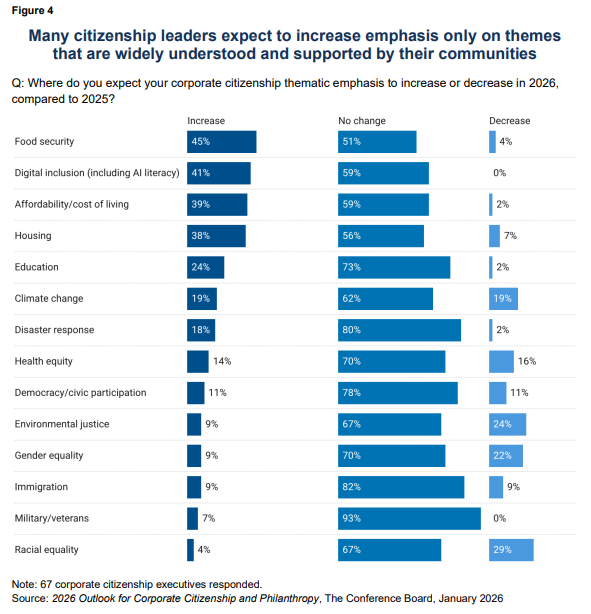
At the same time, the steepest net declines appeared in areas facing higher political, legal, or reputational scrutiny, including “racial equality” and “gender equality,” “environmental justice,” and “health equity.” “Climate change” sits in a transitional position, with similar shares planning increases and decreases. Overall, the pattern reflects pragmatic portfolio management in a more constrained environment, with companies favoring themes that offer clearer, more defensible value while reducing public emphasis on issues that carry greater external risk.
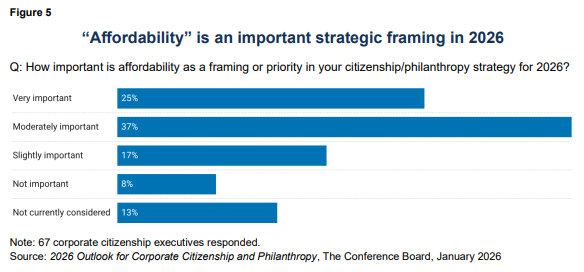
Notably, “affordability”—defined in the survey as the rising cost of living, including housing, food, healthcare, childcare, transportation, and other essentials, and how these pressures shape community needs and citizenship priorities—is emerging in 2026 as a key organizing frame for many citizenship strategies. Nearly two-thirds of respondents (62%) rated affordability as “very” or “moderately” important, while only 21% viewed it as unimportant or out of scope (Figure 5).
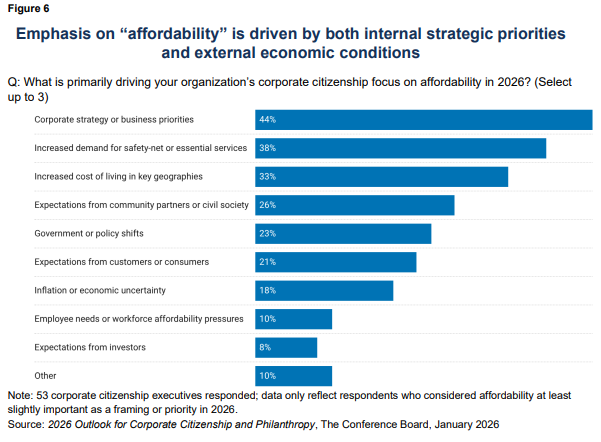
This increased emphasis reflects a combination of internal and external factors (Figure 6), including cost-of-living pressures and evolving federal and state approaches to social spending and safety-net programs. More broadly, “affordability” has become a widely resonant concept across the US landscape, serving as shorthand for everyday economic pressures after several years of elevated inflation, higher interest rates, rising housing and insurance costs, and renewed attention to tariffs and trade policy.
For corporate citizenship leaders, this creates both opportunity and risk. Affordability offers a credible, nonideological entry point for engagement on food access, housing stability, and essential services—areas where public systems are under strain and private-sector capabilities can play a constructive role. At the same time, the growing political resonance of “affordability,” likely to feature prominently in this year’s midterm elections, raises the risk that such efforts are perceived as taking sides. In practice, this reinforces the importance of grounding citizenship initiatives in business relevance and operational context—where companies operate, whom they employ, and how local cost pressures affect resilience—rather than in broader policy advocacy or commentary.
Nonprofit Ecosystem and Resilience
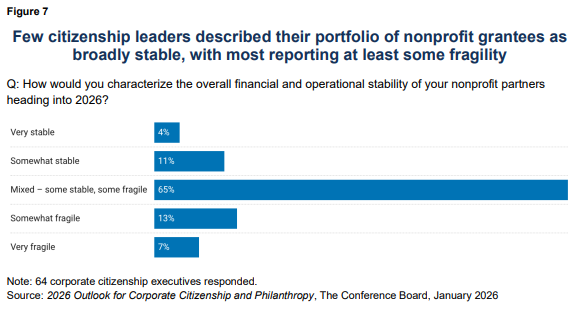
Corporate citizenship relies heavily on nonprofits as a primary delivery channel and implementing partner. However, the US nonprofit sector enters 2026 under significant strain. Many organizations are operating with thin financial buffers, and most citizenship leaders described their nonprofit portfolios as unevenly stressed (Figure 7). This fragility has practical implications for execution: elsewhere in the survey, 63% of respondents expressed concern that nonprofit capacity constraints could affect their ability to achieve citizenship goals, although only 13% said they were “very concerned.”

Among respondents reporting nonprofit fragility, government-linked funding cuts and reductions in social safety net programs were cited overwhelmingly as the primary drivers (Figure 8). In practice this includes recent cuts to Community Development Block Grants, Title I education funding, and Department of Health and Human Services programs. As public funding contracts, nonprofits face simultaneous revenue shocks and rising demand—particularly in health, food, housing, and human services. To support nonprofit partners, corporate citizenship leaders can:
- Provide more multi-year commitments for core partners where continuity matters (especially human services, health access, food systems, housing stability).
- Increase flexible or general operating support where possible; if not, explicitly fund the real full cost of delivery (including overhead, compliance, and data.
- Streamline reporting requirements, especially for smaller partners, and fund measurement capacity when needed.
- Offer pro bono support targeted to the biggest operational bottlenecks: finance, HR, procurement, cybersecurity, IT modernization.
- Coordinate internally with legal and government relations so external giving does not create unintended exposure for the company or the grantee.
Barriers and Opportunities
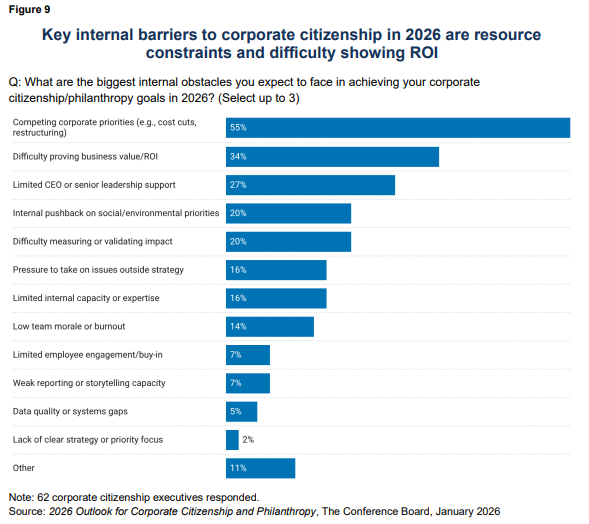
Corporate citizenship leaders cited a wide range of potential impediments to achieving their goals in 2026 (Figure 9). Internally, the top challenge—”competing corporate priorities” (55%)— reflected tighter capital discipline and crowded executive agendas. Close behind, “difficulty proving business value or ROI” (34%) and “limited CEO or senior leadership support” (27%) suggest that citizenship leaders are also being asked to justify programs more rigorously and in clearer business terms. Importantly, issues like unclear strategy (2%) or data systems gaps (5%) ranked low, indicating that most teams believe they know what they want to do—but are constrained by bandwidth, proof points, and internal trade-offs.
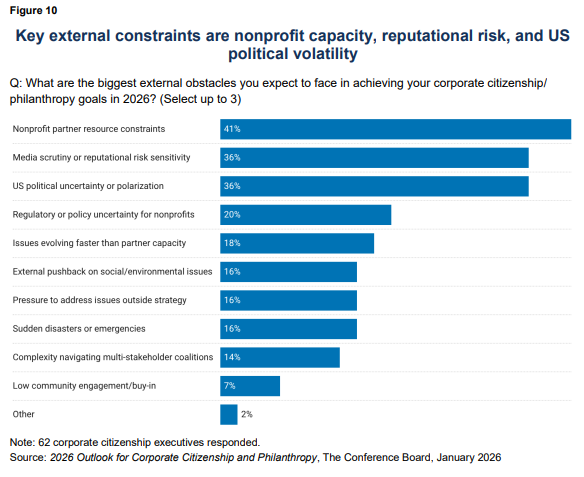
Externally, the barriers are more structural and volatile (Figure 10). “Nonprofit partner resource constraints” (41%) topped the list, consistent with earlier findings on nonprofit fragility. “Media scrutiny or reputational risk sensitivity” and “US political uncertainty or polarization” (36% each) followed, reinforcing that external risk management—guiding how actions are perceived and interpreted—has become as important as program design.
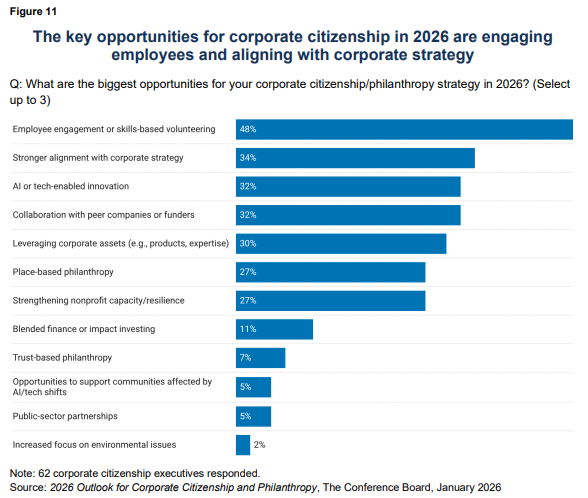
Against this backdrop, the perceived largest opportunities for the year were pragmatic and incremental (Figure 11). The leading opportunity—“employee engagement or skills-based volunteering” (48%)—is not only culturally resonant but also relatively low cost, visible, and controllable. “Stronger alignment with corporate strategy” (34%) and “leveraging corporate assets (e.g., products, expertise)” (30%) also suggest a shared objective to anchor citizenship more tightly to core business capabilities rather than treating it as a parallel or discretionary activity.
In parallel, the selection of “AI or tech-enabled innovation” and “collaboration with peer companies or funders” (32% each) reflected emphasis on doing more with constrained resources and sharing risk. The prominence of “place-based philanthropy” and “strengthening nonprofit capacity/resilience” (27% each) aligned with earlier survey findings: companies likely see value in concentrating efforts geographically and stabilizing delivery partners rather than spreading funding thinly across issues or regions.
AI Adoption and Priorities
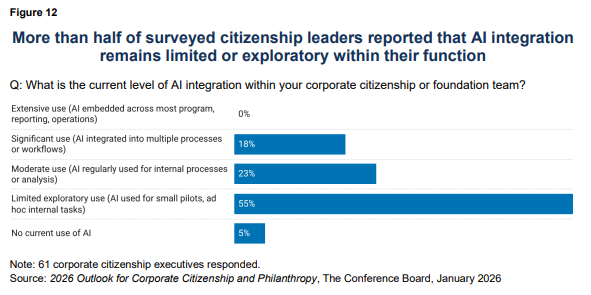
The rapid adoption of AI across the economy is reshaping how organizations operate, make decisions, and allocate resources, with direct implications for corporate citizenship. Yet despite this potential, survey data show that AI adoption within citizenship teams remains early and uneven (Figure 12). A majority of respondents (55%) described their use as limited and exploratory, focused on small pilots or ad hoc tasks rather than embedded capability. Another 23% reported moderate use for internal processes or analysis, while only 18% said AI was meaningfully integrated across multiple workflows; 5% reported no use at all.
Looking ahead, citizenship leaders’ AI priorities for 2026 are therefore pragmatic and inward facing (Figure 13). The top-cited focus was “AI literacy and training for staff” (50%), reflecting recognition that human capability and judgment remain the primary constraints on effective use. This was followed by “data analysis or reporting automation” (39%), “enhanced measurement and evaluation tools” (30%), and “streamlining internal operations” (27%). These priorities reflect an early emphasis on AI as an internal efficiency and decision-support tool rather than a front-facing or programmatic intervention.
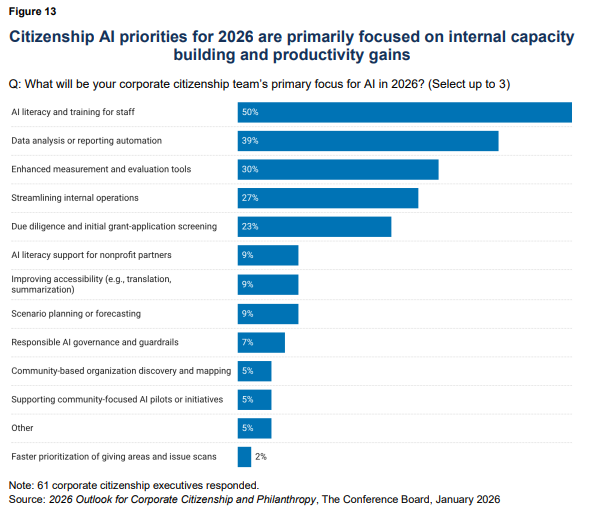
By contrast, far fewer respondents identified AI applications that extend closer to communities or external stakeholders, such as “AI literacy support for nonprofit partners” (9%), “improving accessibility (e.g., translation, summarization)” (9%), “community-based organization discovery and mapping” (5%), and “supporting community-focused AI pilots or initiatives” (5%). While potentially more transformative—shaping how needs are identified, partners are supported, and responses evolve in real time—these uses require capabilities most teams are still developing, including strong data foundations, trusted partnerships, clear accountability, and legal and ethical guardrails. They also carry higher risk, particularly around bias, data privacy, misuse, and reputational exposure, reinforcing a preference for building internal readiness before moving into more visible, higher-impact applications.
Actionable Steps for Corporate Citizenship Leaders in 2026
Corporate citizenship in 2026 is entering a more mature, disciplined phase. Looking ahead, the companies best positioned to sustain impact will be those that:
- Reallocate with intent: Use the current period of budget stability to actively rebalance portfolios—concentrating resources on fewer themes, geographies, and partners where execution risk is lower and business relevance is clearer.
- Anchor to workforce and operating realities: Deepen coordination with HR, facilities, and regional leaders to align volunteering, matched giving, and place-based efforts with where employees live, work, and face cost-of-living pressures.
- Stress-test nonprofit portfolios for delivery risk: Identify which partners are mission critical versus substitutable, and proactively address fragility through multiyear commitments, flexible funding, or targeted capacity support before disruptions occur.
- Use “affordability” as a practical organizing frame: Ground initiatives in local economic conditions, workforce stability, and essential services, and avoid positioning that drifts into policy advocacy or abstract social commentary.
- Build AI readiness before pursuing high-visibility applications: Prioritize staff literacy, data quality, and internal automation in 2026, establishing clear guardrails with legal, IT, and communications before extending AI into partner- or community-facing use cases.
- Prepare for sustained scrutiny, not episodic backlash: Treat reputational, political, and media sensitivity as structural conditions of the operating environment, and embed risk assessment earlier in program design rather than reacting after initiatives launch.
1 The US budget reconciliation measure, Public Law 119-21 (H.R. 1, 2025), signed into law in July 2025 and known widely as the “One Big Beautiful Bill Act,” introduced significant changes to tax policy, health care, and social and environmental programs. Many companies welcomed certain of its business friendly provisions. At the same time, the law reshaped federal priorities in ways that could reduce funding or alter expectations in sectors like clean energy, health care, and social services. A recent article from The Conference Board examined key implications for corporate citizenship and philanthropy leaders, with a key focus on new tax deduction thresholds for corporate giving.(go back)
Legal Disclaimer:
EIN Presswire provides this news content "as is" without warranty of any kind. We do not accept any responsibility or liability for the accuracy, content, images, videos, licenses, completeness, legality, or reliability of the information contained in this article. If you have any complaints or copyright issues related to this article, kindly contact the author above.
